
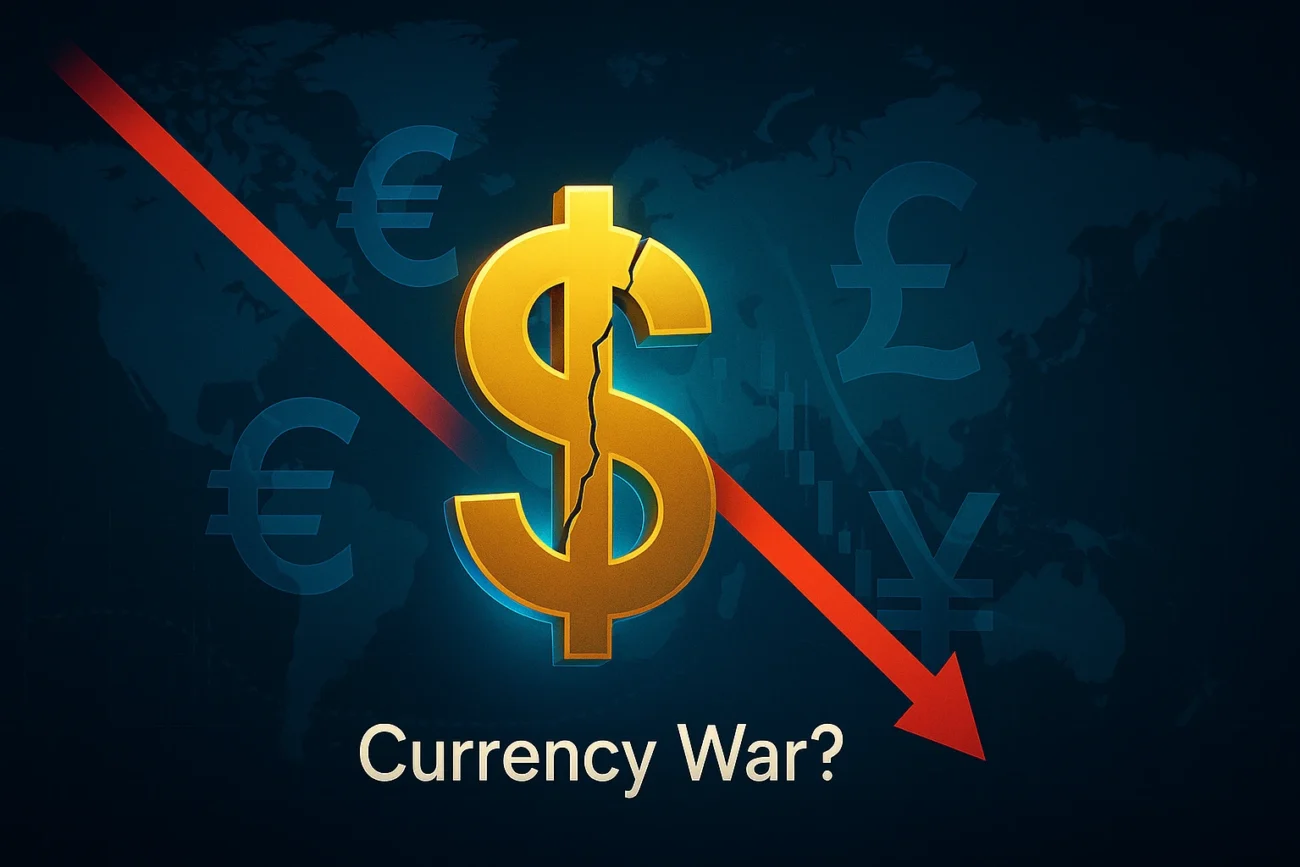
In recent years, whenever the US dollar shows signs of weakening, the world becomes increasingly anxious about a potential “currency devaluation race.” Why does a fluctuation that seems to affect only the United States carry such a profound impact on the global economy—especially for export-driven nations?
1. When the USD Weakens – A Global Domino Effect
The USD is not just the currency of the United States; it is the world’s reserve currency, playing a central role in trade, investment, and the pricing of major financial assets. When the USD weakens (i.e., its value declines against other major currencies), countries that rely heavily on exports or foreign capital inflows immediately face significant risks:
-
Exported goods become more expensive for American buyers.
-
Foreign capital may withdraw or shift to higher-yielding markets.
-
The domestic currency appreciates too rapidly, eroding export competitiveness.
2. How Do Countries Respond?
To prevent their local currencies from appreciating too strongly (when the USD weakens), central banks are often forced to loosen monetary policy or print money to buy USD—effectively injecting more local currency into the market to keep exchange rates in check.
However, this approach inadvertently increases the overall money supply, leading to an almost inevitable return of inflation.
If one country devalues its currency to support exports, competing nations are forced to follow suit to maintain their competitive edge—triggering a “currency war”, a destructive cycle that has shaken global financial markets many times.
3. The Instability Spiral: Exchange Rates – Exports – Inflation
When many countries devalue their currencies simultaneously:
-
Global inflation rises as excessive money supply drives commodity and consumer prices higher.
-
Exchange rate volatility makes it difficult for businesses to plan, price, and hedge against risks.
-
Confidence in fiat currencies declines, driving capital flows into safe-haven assets like gold, real estate, and increasingly, cryptocurrencies.
The dangerous truth is that if everyone enters this race, no one truly wins. Instead, all participants suffer the consequences—higher inflation, economic instability, and widespread uncertainty across financial markets.
4. Real-World Examples & Risk Management Lessons
-
2010–2013: Following the global financial crisis, the US implemented Quantitative Easing (QE), causing the USD to weaken. The world entered a competitive currency devaluation cycle to protect exports. Result: inflation surged across many emerging markets.
-
2022–2023: As the Fed aggressively tightened monetary policy, the USD soared. Many countries (including Vietnam) were forced to intervene heavily in FX markets, selling off foreign exchange reserves to stabilize their domestic currencies. Currency market tensions remained high.
Key Takeaway:
No country can continually devalue its currency to gain an unfair export advantage without eventually paying the price in the form of inflation and macroeconomic instability.
Investors, businesses, and even individuals must understand the crucial relationship between exchange rates, monetary policy, and inflation to protect themselves and allocate assets wisely.
5. Strategic Advice for Investors and Businesses
-
Diversify your assets: Never “go all-in” on a single currency. Maintain a mix of USD, your local currency, and defensive assets like gold and real estate.
-
Hedge FX risk proactively: Use forward contracts, options, or other hedging tools—especially if your business is heavily involved in import/export operations.
-
Closely monitor monetary policies of major central banks (FED, ECB, PBOC, BOJ…). Staying updated allows you to adjust your portfolio promptly and avoid being caught off guard by major FX swings.
-
Re-evaluate outdated assumptions: Markets constantly change. A strategy that brought huge returns last year may become a disaster this year if not continuously updated.
Conclusion: Know Yourself, Know the Market – Risk Management is Long-Term Victory
The currency devaluation race is an unavoidable byproduct of globalization. But no one can win indefinitely by trading economic stability for short-term export gains. Only investors and businesses who master risk management, allocate flexibly, and understand large-scale capital flows can survive and thrive through the storms of currency volatility.
If you’re holding foreign assets, involved in import/export, or simply want to preserve the value of your money, start by understanding and managing exchange rate risks today. It’s the essential foundation of all long-term success in finance.